Case study, 2025
Hack@MUIC Platform
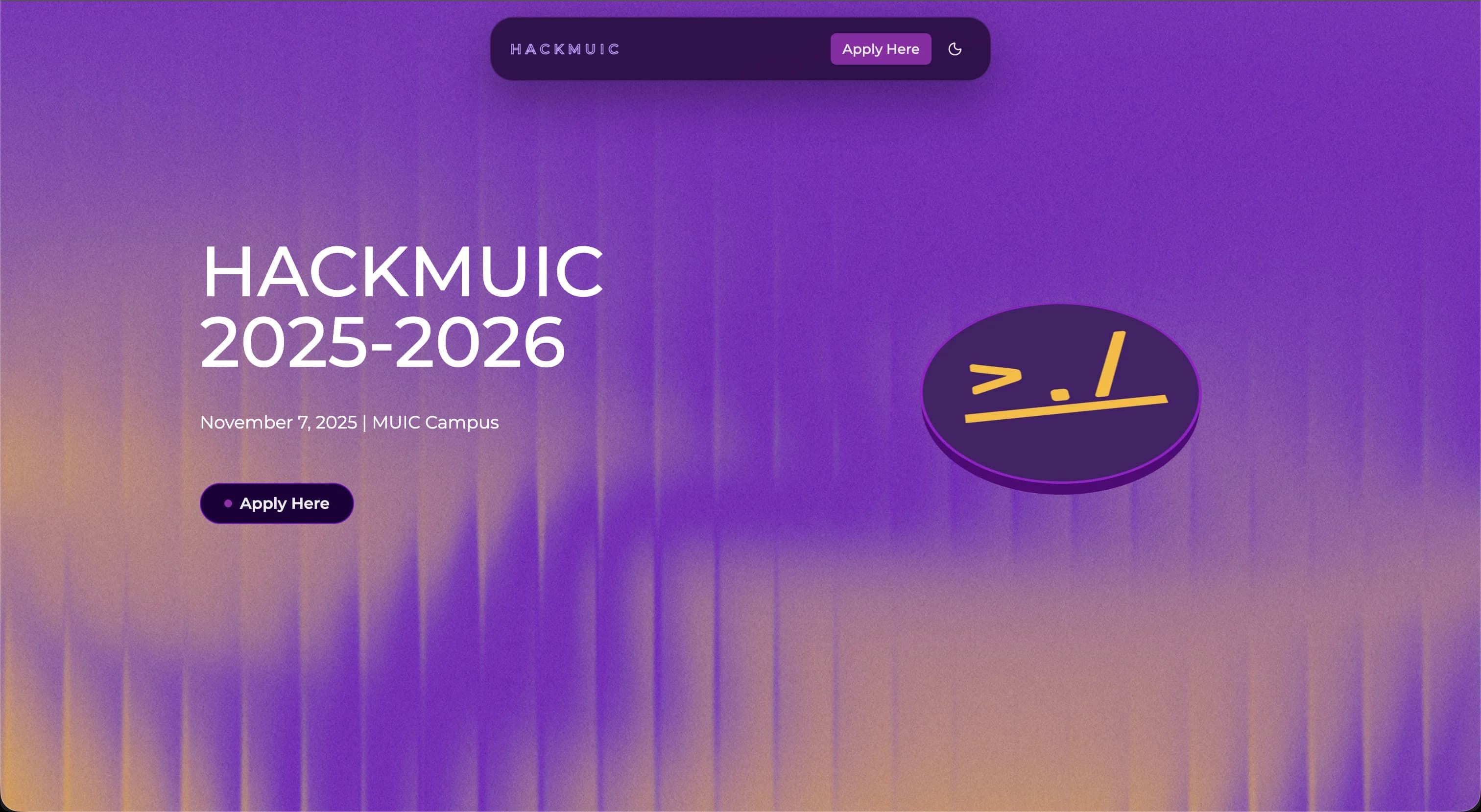
Mahidol University International College’s student-run hackathon needed more than a landing page. It needed a fast site the club could re-skin every year, and a way for non-technical organizers to update tracks, schedules, and FAQs without touching code.
- Role
- Design & engineering
- Stack
- Next.js, Sanity, Tailwind, R3F
- Year
- 2025
- Live
- hackmuic.org
The brief
A hackathon site that outlives its hackathon.
Hackathon sites usually die the week after the event. Hard-coded dates, hand-edited HTML, one person who knows where everything lives. I wanted to break that cycle. The site needed to feel loud enough for a student hackathon, but structured enough that next year’s organizing team would inherit a working system, not a pile of markup.
One repository powers both halves.
- The public Next.js site, at the root.
- A standalone Sanity Studio package the organizing team uses to manage content.
Content
Editors publish. The site updates itself.
Event details, tracks, schedule, FAQs, and team credits all live in Sanity, a headless CMS with schemas defined per content type. Club members sign in with Google on the hosted Studio, edit in a plain UI, and hit publish. The site revalidates every sixty seconds, so changes go live within a minute. No deploys, no pull requests, no single person who has to be around to make a change.
Display order across the site comes from a single order field on each document, lowest first. Same mental model everywhere, from tracks to team groups.
Resilience
If the CMS is empty, the site still renders.
Every content type has static fallback values checked into the repo. Anything left unpublished, or a CMS outage entirely, falls back to those defaults. The site always renders something coherent, so editors can work incrementally without leaving the public site half-broken.
Motion & 3D
Interactive visuals, budgeted like everything else.
Framer Motion drives the interface motion. React Three Fiber powers the 3D moments on the landing page. Both sit on the same design system, Tailwind, Radix UI, and class-variance-authority.
Handoff
Built to be inherited.
One pnpm workspace installs both packages. The Studio deploys to a hosted URL, so editors install nothing. Inviting a new organizer takes one email, under Members. The 2025 edition is archived on the same platform the next team will reuse.